

Summary: Screening tenants in Portland is one of the most legally sensitive things a landlord does - and the rules go well beyond federal fair housing law. Oregon and Portland have layered in additional protected classes and screening requirements that many landlords aren't fully aware of. This guide covers who is protected, what criteria you can and can't use, how to structure a compliant screening process, and the documentation habits that protect you if your decisions are ever challenged.
⏱ 6-minute read
How to Screen Tenants in Portland Without Violating Fair Housing Laws
Tenant screening is where many well-intentioned Portland landlords accidentally run into legal trouble. Not because they're trying to discriminate - but because Oregon and Portland's fair housing rules go significantly further than federal law, and staying compliant requires knowing the full picture.
At Uptown Properties, tenant screening is one of the most important and carefully managed parts of what we do. Done right, it finds you a qualified, reliable tenant. Done wrong, it exposes you to complaints, civil liability, and fines. Here's what you need to know.
The Three Layers of Fair Housing Law That Apply in Portland
Portland landlords operate under three overlapping layers of fair housing protection:
Federal - The federal Fair Housing Act prohibits discrimination based on race, color, national origin, religion, sex, familial status, and disability.
Oregon state law - Oregon's fair housing statutes go further, adding marital status, sexual orientation, gender identity, and source of income as protected classes under Oregon Revised Statutes Chapter 659A. Source of income protection means you cannot refuse to rent to an applicant simply because they use a Section 8 voucher, rental assistance, Social Security, disability benefits, or other legal income sources. In May 2025, Oregon SB 599 added immigration status as a distinct protected class as well.
Portland city code - Portland's Title 30 adds additional layers of tenant protection specific to rental housing within city limits, including detailed requirements around how screening criteria must be structured, disclosed, and applied. Portland City Code 30.01.086 was last updated effective January 1, 2025.
Violations at any of these levels can result in formal complaints with the Bureau of Development Services, civil lawsuits, or HUD enforcement actions. Portland landlords who fail to comply with screening requirements under Title 30 are liable for up to $250 per violation plus actual damages.
What You Can Screen For - And How
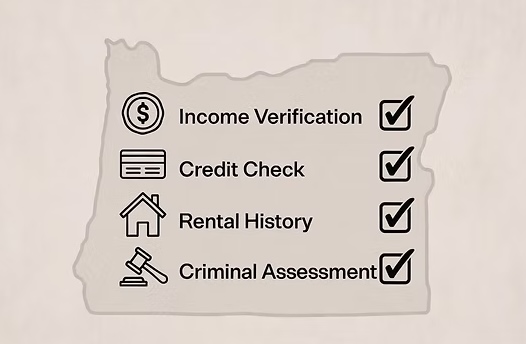
The good news: you absolutely can screen tenants. You can require verifiable income, check credit history, review rental history, and apply objective criteria to evaluate applicants. The key is that your criteria must be written, objective, and applied consistently to every single applicant.
Income requirements - The most common standard is requiring monthly income of 2.5 to 3 times the monthly rent. Portland's Rental Housing Application and Screening Minimum Income Requirement, updated by the Portland Housing Bureau in May 2025, provides guidance on how income minimums must be calculated and applied, particularly where source of income protections are involved. You cannot apply a stricter income threshold to a Section 8 voucher holder than to any other applicant.
Credit history - Reviewing credit is permitted, but blanket minimum credit score requirements can create fair housing risk if applied without context. Look at the overall picture: payment history, outstanding debt, recent bankruptcies or evictions. Document your reasoning.
Rental history - Past landlord references and rental payment history are legitimate screening criteria. Eviction history may also be considered, with one important exception: under Oregon SB 282, landlords are prohibited from considering any eviction court actions that occurred between April 2, 2020 and March 1, 2022, regardless of the outcome. This COVID-era prohibition remains in effect.
Criminal history - Oregon's Fair Chance Housing Law significantly restricts when and how landlords can consider criminal records. In Portland specifically, landlords generally cannot consider arrest records that did not result in conviction, and must follow specific procedures before denying an applicant based on criminal history. This is a complex area - if criminal history is part of your screening criteria, consult with a property management professional or attorney familiar with current Portland code.
What You Cannot Screen For
Beyond the protected classes listed above, there are several screening practices that are explicitly prohibited:
You cannot ask about or consider an applicant's immigration status as a basis for denial (SB 599, effective May 2025). You cannot reject an applicant because their income comes from rental assistance, housing vouchers, Social Security, or other legal sources. You cannot apply different screening standards to different applicants based on any protected characteristic - even subtly, such as requiring additional documentation from some applicants but not others.
Your rental advertisements also fall under fair housing rules. Language like "ideal for single professionals," "no children," "quiet building for working adults," or anything that signals a preference for or against a protected class is prohibited. Describe the property - not the ideal tenant.
The Process: How to Screen Compliantly
Step 1 - Publish your screening criteria before accepting applications. Under Oregon law (ORS 90.295) and Portland City Code, you must disclose your written screening criteria to applicants before collecting any application fee or holding deposit. These criteria must be objective and in writing. No surprises, no moving goalposts.
Step 2 - Charge a lawful screening fee. Under ORS 90.295, a screening fee can only cover the actual cost of obtaining applicant information - credit reports, background checks, reference verification. You may only collect one screening fee from an applicant in any 60-day period across all your units, and you must provide a receipt.
Step 3 - Review applications in the order received. Portland's code requires landlords to process applications in the order they are received and to offer the unit to the first qualified applicant who meets the published criteria. You cannot skip over a qualified applicant to wait for a "better" one.
Step 4 - Apply your criteria identically to every applicant. This is the most important rule and the most common source of violations. Every applicant gets the same process, the same criteria, and the same documentation review. No exceptions.
Step 5 - If you deny, provide a written denial with reasons. Under Oregon law, if you deny an applicant, you must provide a written explanation of the reasons tied to your stated criteria. If a consumer report was used in the decision, the applicant has rights under federal law to obtain a copy.
Documentation: Your Best Protection
If a fair housing complaint is ever filed against you, your documentation is everything. Keep a written record of every application received, the order in which applications came in, the criteria applied, and the outcome with reasoning. If you approved one applicant over another, be able to show - in writing - exactly why, tied to your published screening criteria.
Inconsistency is the most common reason landlords lose fair housing disputes. A landlord who approved a similar application under different circumstances but denied this one, without documentation showing why the cases were different, is in a difficult position.
Fair Housing Resources in Portland
The Fair Housing Council of Oregon provides education, technical assistance, and enforcement resources for both landlords and tenants. The Portland Housing Bureau (portland.gov/phb) maintains current guidance on rental housing rules, screening requirements, and fair housing obligations. Multifamily NW is a regional association that provides Oregon-specific landlord education and compliant rental forms.
Let Us Handle It
Tenant screening is one of the highest-risk activities in property management - and one of the areas where working with an experienced professional pays for itself quickly. At Uptown Properties, our screening process is built around current Oregon and Portland requirements, applied consistently to every applicant, with full documentation maintained throughout.
- Own a rental property? We handle screening, leasing, and compliance so you don't have to navigate it alone.
- Thinking about buying? Our brokerage team can help you find the right investment property and set it up for success.
- Looking for a rental? We manage quality homes across Portland and the metro area.